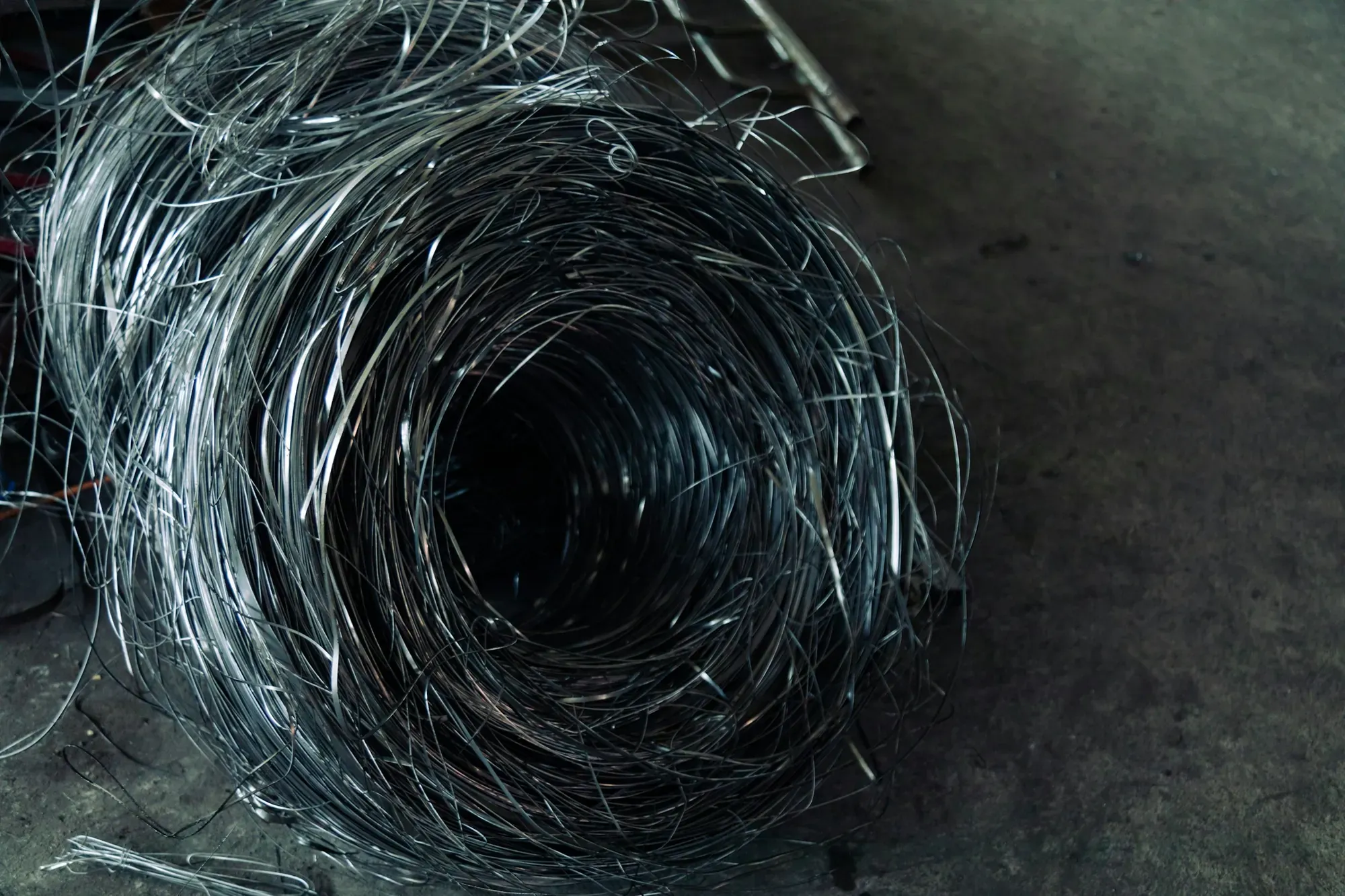
Cold drawn mild steel wire, drawn down from rod and coil stock across the full commercial range: 7.01 mm at 2 SWG through to 0.56 mm at 24 SWG. Drawing is done in successive passes rather than one, which is what holds the diameter along the length of the coil instead of only at the ends.
Three tempers come off the same line. Hard drawn wire keeps the strength the drawing puts into it and goes to welded mesh, nails, fasteners and light springs. Annealed wire is softened afterwards — this is the black binding wire that ties reinforcement on site, soft enough to twist by hand and hold. Galvanized wire is drawn then zinc coated, for fencing, tying and anything that lives outdoors.
The gauge decides the job. The heavy end, 2 to 8 SWG, is drawn for mesh, fencing and wire rope core; the middle, 10 to 16 SWG, for nails, fasteners and light mesh; the fine end, 18 to 24 SWG, for binding, tying and stitching wire. The table below lists the principal gauges, and intermediate gauges are quoted on enquiry.
Wire is ordered by gauge but made to a diameter, so the millimetre governs and the gauge is the shorthand. Coils are supplied to weight, and the running weight in the table converts between the two: at 18 SWG a kilogram is 109 metres, at 2 SWG it is barely three.
Applications
- Binding wire for reinforcement
- Welded mesh and wire fencing
- Nail and fastener manufacture
- Chain link and chicken mesh
- Light springs and clips
- Wire rope core
- Baling, tying and stitching wire
- General fabrication
Sectors supplied
- Construction
- Fastener manufacture
- Mesh and fencing
- Agriculture
- Packaging
- Fabrication